

Outlook for the Artificial Intelligence (AI)-Generated Personalized Medical Reminder Market to 2030: Size, Growth Rate

The Business Research Company
Artificial Intelligence (AI)-Generated Personalized Medical Reminder market
The Business Research Company’s Artificial Intelligence (AI)-Generated Personalized Medical Reminder Market Global Market Report 2026 – Market Size 2026-2035
LONDON, GREATER LONDON, UNITED KINGDOM, November 3, 2026 /EINPresswire.com/ -- The surge in healthcare technology has brought significant advancements, particularly in personalized medical reminders powered by artificial intelligence (AI). This evolving market is witnessing rapid growth as it addresses critical needs in patient care and medication management. Let’s explore the current market size, key drivers, regional leadership, and future trends shaping the AI-generated personalized medical reminder sector.
Market Size and Growth Expectations for the AI-Generated Personalized Medical Reminder Market
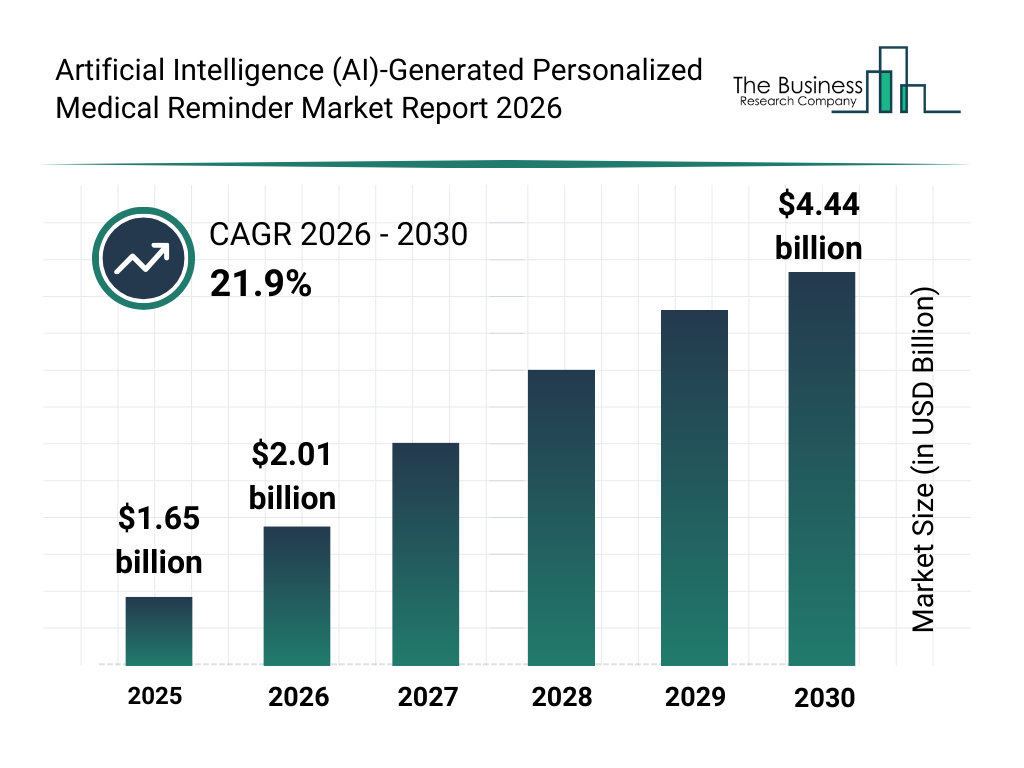
The AI-generated personalized medical reminder market has experienced remarkable expansion recently. It is projected to grow from $1.65 billion in 2025 to $2.01 billion in 2026, representing a strong compound annual growth rate (CAGR) of 22.2%. This impressive increase can be linked to factors such as the rising incidence of chronic diseases, greater smartphone use in healthcare settings, wider acceptance of digital health tools, growth in remote patient monitoring initiatives, and heightened emphasis on medication adherence.
Download a free sample of the artificial intelligence (ai)-generated personalized medical reminder market report:
https://thebusinessresearchcompany.com/sample_request?id=54849296&type=smp&name=Artificial%20Intelligence%20%28AI%29-Generated%20Personalized%20Medical%20Reminder%20Market%20Report%202026&utm_source=EINPresswire&utm_medium=Paid&utm_campaign=Oct_PR
Looking ahead, this market is expected to continue its rapid upward trajectory, reaching $4.44 billion by 2030 with a CAGR of 21.9%. The forecasted growth is driven by improvements in AI health algorithms’ accuracy, increasing demand for tailored healthcare solutions, expansion of cloud-based health platforms, deeper integration with electronic health records (EHRs), and a broader adoption of preventive health technologies. Key developments anticipated during this period include widespread use of AI-based medication adherence platforms, enhanced connectivity with wearable and smart devices, advanced predictive analytics for optimizing reminders, expansion of personalized health notification systems, and greater focus on patient engagement tools.
Understanding AI-Generated Personalized Medical Reminders and Their Benefits
AI-generated personalized medical reminders are digital systems designed to deliver customized notifications for medication and medical routines. By utilizing AI to analyze individual health data and patterns, these reminders optimize the timing and relevance of notifications. Such intelligent systems help improve medication adherence, minimize missed doses, support consistent health management, and reduce the mental effort required from users to keep track of complex health schedules.
View the full artificial intelligence (ai)-generated personalized medical reminder market report:
https://thebusinessresearchcompany.com/report/artificial-intelligence-ai-generated-personalized-medical-reminder-global-market-report?utm_source=EINPresswire&utm_medium=Paid&utm_campaign=Oct_PR
How Rising Non-Communicable Diseases Propel Market Expansion
One of the primary factors accelerating the growth of the AI-generated personalized medical reminder market is the increasing prevalence of non-communicable diseases (NCDs). These chronic conditions—such as diabetes, cardiovascular diseases, and cancer—are not caused by infectious agents and cannot be transmitted between people. Sedentary lifestyles contribute heavily to the rise of NCDs by impairing the body’s ability to regulate critical functions like weight, blood pressure, and metabolism, which leads to long-term health challenges.
AI-based personalized reminders play a vital role in managing these diseases by issuing timely alerts for medication intake, lifestyle changes, and follow-up appointments. This helps patients adhere better to treatment plans and achieve improved health outcomes. For example, in February 2024, the World Health Organization reported that by 2050, new cancer cases worldwide are expected to exceed 35 million—a 77% increase from the estimated 20 million cases in 2022—highlighting the urgent need for effective management tools like AI-driven reminders.
Which Geography Leads the AI-Generated Personalized Medical Reminder Market?
In 2025, North America held the dominant position in the AI-generated personalized medical reminder market. However, the Asia-Pacific region is forecasted to experience the fastest growth throughout the upcoming years. The market analysis encompasses regions such as Asia-Pacific, South East Asia, Western Europe, Eastern Europe, North America, South America, the Middle East, and Africa, providing a comprehensive view of global market dynamics and opportunities.
New additions to our 2026 reports:
• Market attractiveness scoring and analysis
• Total addressable market (TAM) analysis
• Company scoring matrix graphics and tables
• Excel-based forecasting dashboards
• Market hotspots infographics
• Key technologies and future trend analysis
• Updated graphics and tables
Speak With Our Expert:
Saumya Sahay
Americas +1 310-496-7795
Asia +44 7882 955267 & +91 8897263534
Europe +44 7882 955267
Email: marketing@tbrc.info
The Business Research Company - www.thebusinessresearchcompany.com
Follow Us On:
• LinkedIn: https://in.linkedin.com/company/the-business-research-company
Oliver Guirdham
The Business Research Company
+44 7882 955267
info@tbrc.info
Visit us on social media:
LinkedIn
Facebook
X
Legal Disclaimer:
EIN Presswire provides this news content "as is" without warranty of any kind. We do not accept any responsibility or liability for the accuracy, content, images, videos, licenses, completeness, legality, or reliability of the information contained in this article. If you have any complaints or copyright issues related to this article, kindly contact the author above.
