

Visible Light Communication Market Size to Reach USD 130.19 Billion, Growing at 37.5% CAGR by 2035
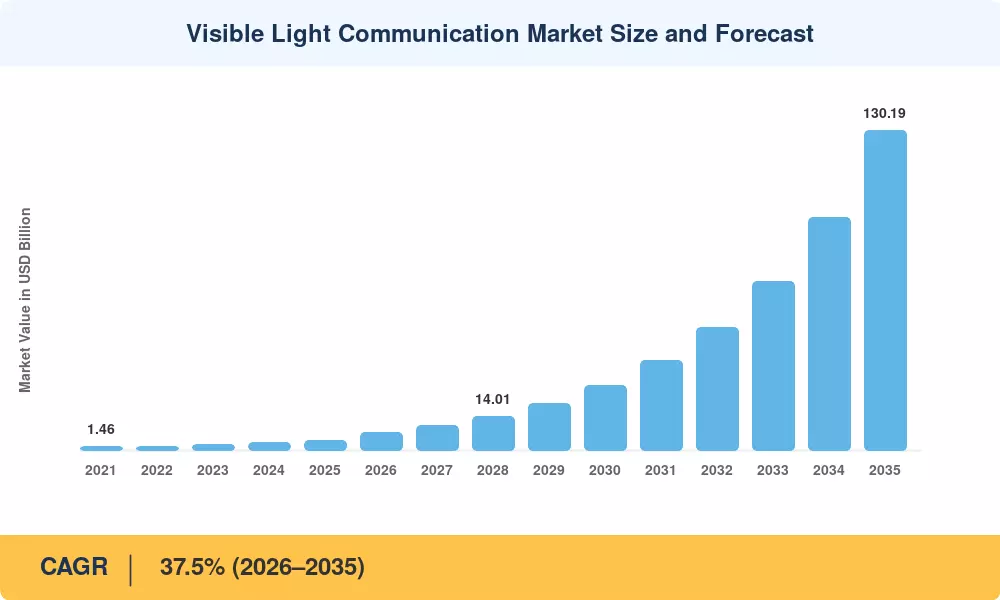
Visible Light Communication Market
Visible Light Communication Market is expanding as LED-based data transmission gains adoption across smart lighting, indoor connectivity, and IoT applications.
Visible Light Communication is transforming LED lighting into a data network, enabling fast, secure, and energy-efficient connectivity for smart buildings, IoT, and mobility.”
PARIS, PARIS, FRANCE, September 7, 2026 /EINPresswire.com/ -- Visible Light Communication (VLC) uses LED-based light sources to transmit data through rapidly modulated visible light signals. The technology combines illumination and wireless communication, creating opportunities across indoor connectivity, smart infrastructure, healthcare, transportation, defense, and industrial environments where conventional radio-frequency communication may face limitations.— Market Research Future
The Visible Light Communication Market is gaining momentum as organizations seek high-speed, secure, and spectrum-efficient wireless technologies. VLC can operate through existing LED lighting infrastructure, supporting data transmission while reducing dependence on conventional radio-frequency networks in selected applications.
Growing adoption of connected devices, smart lighting, intelligent buildings, and location-based services is expanding the addressable market for VLC solutions. Integration with optical wireless communication, sensors, edge computing, and intelligent networking is also creating new use cases across commercial and industrial environments.
Visible Light Communication Market reached USD 4.15 Billion in 2025 and is projected to grow from USD 7.41 Billion in 2026 to USD 130.19 Billion by 2035, registering a CAGR of 37.5% during the forecast period.
Download Exclusive Sample Copy of This Report Here -
https://www.marketresearchfuture.com/sample_request/2559
Key Market Drivers
One major driver is the rapid deployment of LED lighting systems. Since VLC can use LED luminaires as communication infrastructure, organizations can potentially combine lighting and connectivity within the same environment, reducing infrastructure duplication and supporting smart-building applications.
Demand for secure wireless communication is another important factor. Visible-light signals generally remain within illuminated spaces and do not penetrate opaque walls, which can provide advantages for applications requiring localized communication and reduced radio-frequency interference.
The expansion of smart cities is further supporting market development. Connected streetlights, traffic infrastructure, indoor navigation, intelligent transportation systems, and public facilities can use optical communication technologies to exchange information between devices and infrastructure.
Artificial Intelligence Market Integration
The Artificial Intelligence Market is becoming increasingly relevant to visible light communication as AI can improve network management, signal optimization, device coordination, and predictive maintenance. Machine learning algorithms can analyze communication conditions and dynamically optimize transmission parameters for changing environments.
AI-enabled VLC systems can also support intelligent positioning, anomaly detection, traffic prediction, and automated resource allocation. Combining AI with optical wireless communication could therefore help organizations develop more adaptive connectivity solutions for smart buildings, factories, transportation systems, and connected infrastructure.
Technology Trends
Hybrid connectivity is emerging as an important direction for VLC development. Instead of replacing Wi-Fi, 5G, or other wireless technologies, VLC can operate alongside them, allowing networks to select communication technologies according to location, application requirements, interference conditions, and security considerations.
Li-Fi is another major technology area associated with visible light communication. Li-Fi systems can provide bidirectional wireless communication through light, potentially delivering high-speed connectivity in environments where spectrum availability, electromagnetic interference, or security requirements create challenges for conventional wireless networks.
Healthcare Applications
Healthcare facilities represent an important opportunity because certain medical environments can benefit from communication technologies that minimize radio-frequency interference. VLC can potentially support patient monitoring, asset tracking, indoor positioning, and data communication within designated areas.
Smart hospital infrastructure can combine LED lighting, sensors, location systems, and communication platforms. VLC-based positioning may also help identify medical equipment and improve navigation within large healthcare facilities, supporting operational efficiency and asset utilization.
Automotive and Transportation Applications
VLC technology can support intelligent transportation by enabling communication between LED-based infrastructure and vehicles or devices. Vehicle headlights, taillights, traffic signals, and streetlights can potentially become communication nodes for exchanging localized information.
In intelligent transportation systems, optical communication could complement existing wireless networks for applications such as traffic management, vehicle identification, road safety alerts, and positioning. Increasing investments in connected mobility and smart roads may create additional opportunities for VLC providers.
Industrial and Enterprise Applications
Factories and industrial facilities are adopting connected technologies to improve automation, monitoring, and productivity. VLC can support localized communication between machines, sensors, autonomous equipment, and infrastructure, particularly in environments where electromagnetic interference is a concern.
Enterprise buildings can also integrate VLC with smart lighting and indoor positioning. Offices, warehouses, retail environments, and logistics facilities may use light-based connectivity for navigation, asset tracking, data transmission, and location-aware services.
Direct Purchase this Research Report -
https://www.marketresearchfuture.com/checkout?currency=one_user-USD&report_id=2559
Regional Market Share Analysis
North America held a 34.9% market share in 2025, supported by investment in secure communications, defense technologies, healthcare infrastructure, and advanced wireless systems. Defense secure-link requirements and RF-free hospital zones represent notable investment themes that can encourage adoption of optical wireless communication.
Europe accounted for a 24.2% share in 2025, with market development supported by smart-building initiatives, sustainability objectives, digital infrastructure programs, and research funding. Horizon Europe-related investment can contribute to research and commercialization of next-generation communication technologies.
Asia-Pacific is expected to demonstrate the strongest regional growth, with a 44.8% CAGR from 2026 to 2035. Government-backed research, smart-city development, LED infrastructure expansion, and greenfield digital projects are creating favorable conditions for VLC deployment across multiple countries.
South America represented approximately USD 0.33 Billion in 2025. LED street-lighting modernization is an important investment theme, as municipalities increasingly explore energy-efficient lighting and connected infrastructure for urban development and public services.
The Middle East & Africa region accounted for a 6.9% share in 2025. Airport connectivity, tourism infrastructure, smart-city projects, and large-scale digital development programs are creating opportunities for VLC-based indoor positioning and localized wireless communication.
Market Opportunities
The growing convergence of lighting, connectivity, and sensing presents significant opportunities for VLC manufacturers and technology providers. Smart buildings can use a single lighting infrastructure for illumination, communication, positioning, and environmental sensing, potentially improving infrastructure efficiency.
Indoor navigation is another promising opportunity. Shopping centers, airports, hospitals, museums, warehouses, and large commercial buildings can use light-based positioning to deliver location-aware services. This can support navigation, asset tracking, personalized experiences, and operational management.
Security and Privacy Potential
Because visible light typically requires a line-of-sight or controlled optical path, VLC can provide useful characteristics for localized communication. Signals can be geographically confined more easily than radio signals in certain indoor environments, making the technology attractive for selected security-sensitive applications.
However, VLC is not automatically secure. Physical access, optical interception, device vulnerabilities, and network-layer weaknesses still need to be addressed. Strong encryption, authentication, access controls, and secure network architecture remain essential for commercial deployments.
Challenges Facing the Market
Despite its growth potential, VLC faces several technical and practical challenges. Direct sunlight, physical obstructions, lighting conditions, receiver positioning, and the requirement for suitable LED and photodetector infrastructure can affect system performance.
Another challenge is interoperability. Successful adoption requires VLC systems to integrate with existing networking technologies and enterprise infrastructure. Standardization, equipment costs, deployment complexity, and awareness among potential customers can also influence commercialization.
Competitive Landscape
Competition in the VLC ecosystem includes companies developing Li-Fi systems, optical transceivers, LED communication components, networking platforms, positioning solutions, and integrated smart-lighting technologies. Vendors are increasingly focusing on higher data rates, improved reliability, interoperability, and application-specific solutions.
Strategic partnerships between lighting manufacturers, semiconductor companies, telecommunications providers, infrastructure developers, and technology firms can accelerate commercialization. Research collaborations are also important for improving optical communication performance and expanding practical use cases.
Browse In-depth Market Research Report -
https://www.marketresearchfuture.com/reports/visible-light-communication-market-2559
Future Outlook
The future of the Visible Light Communication Market is closely connected with the evolution of smart infrastructure. As buildings, factories, transportation networks, healthcare facilities, and cities become increasingly connected, the ability to integrate communication into existing lighting infrastructure could create new deployment models.
Over the longer term, VLC is likely to complement rather than completely replace conventional wireless technologies. Hybrid networks combining VLC, Wi-Fi, 5G, edge computing, and AI could provide organizations with flexible connectivity based on performance, security, location, and application requirements.
Key Takeaways
The Visible Light Communication Market is entering a high-growth phase driven by LED adoption, smart infrastructure, secure connectivity requirements, and optical wireless innovation. Healthcare, transportation, industrial automation, smart buildings, and indoor positioning represent major application opportunities.
The market's projected expansion from USD 7.41 Billion in 2026 to USD 130.19 Billion by 2035 highlights the increasing commercial potential of light-based communication. Integration with the Artificial Intelligence Market, IoT, edge computing, and smart-city infrastructure could further expand its role in next-generation connectivity.
Frequently Asked Questions:
What is Visible Light Communication?
Visible Light Communication uses modulated visible light, typically from LEDs, to transmit digital information wirelessly.
What is driving the VLC market?
LED deployment, smart cities, secure communication, healthcare applications, and demand for high-speed wireless connectivity are key drivers.
Which region is growing fastest?
Asia-Pacific is projected to grow fastest, with a 44.8% CAGR during 2026–2035.
How is AI related to VLC?
AI can optimize signals, manage networks, improve positioning, detect anomalies, and support predictive maintenance.
What are major VLC applications?
Major applications include smart lighting, healthcare, transportation, industrial automation, indoor positioning, defense, and smart buildings.
What is the market outlook?
The market is projected to reach USD 130.19 billion by 2035, reflecting strong long-term growth potential.
➤➤ Regional & Country-Level Reports by Market Research Future:
South America Visible Light Communication Market -
https://www.marketresearchfuture.com/reports/south-america-visible-light-communication-market-62214
➤➤ Featured Insights from Market Research Future:
Robotics Technology Market -
https://www.marketresearchfuture.com/reports/robotics-technology-market-33899
Enterprise Capture Software Market -
https://www.marketresearchfuture.com/reports/enterprise-capture-software-market-34034
Hadoop Distribution Market -
https://www.marketresearchfuture.com/reports/hadoop-distribution-market-34035
Wigig Market -
https://www.marketresearchfuture.com/reports/wigig-market-34057
Enterprise Network Equipment Market -
https://www.marketresearchfuture.com/reports/enterprise-network-equipment-market-34080
High Altitude Aeronautical Platform Station Market -
https://www.marketresearchfuture.com/reports/high-altitude-aeronautical-platform-station-market-34100
Access Control Hardware Market -
https://www.marketresearchfuture.com/reports/access-control-hardware-market-34380
Aerial Photogrammetry Software Market -
https://www.marketresearchfuture.com/reports/aerial-photogrammetry-software-market-34386
2D And 3D Machine Vision System Market -
https://www.marketresearchfuture.com/reports/2d-and-3d-machine-vision-system-market-34403
Market Research Future
Market Research Future
+1 855-661-4441
email us here
Legal Disclaimer:
EIN Presswire provides this news content "as is" without warranty of any kind. We do not accept any responsibility or liability for the accuracy, content, images, videos, licenses, completeness, legality, or reliability of the information contained in this article. If you have any complaints or copyright issues related to this article, kindly contact the author above.
