

Antimicrobial Textile Market Size to Reach USD 25.55 Billion by 2035
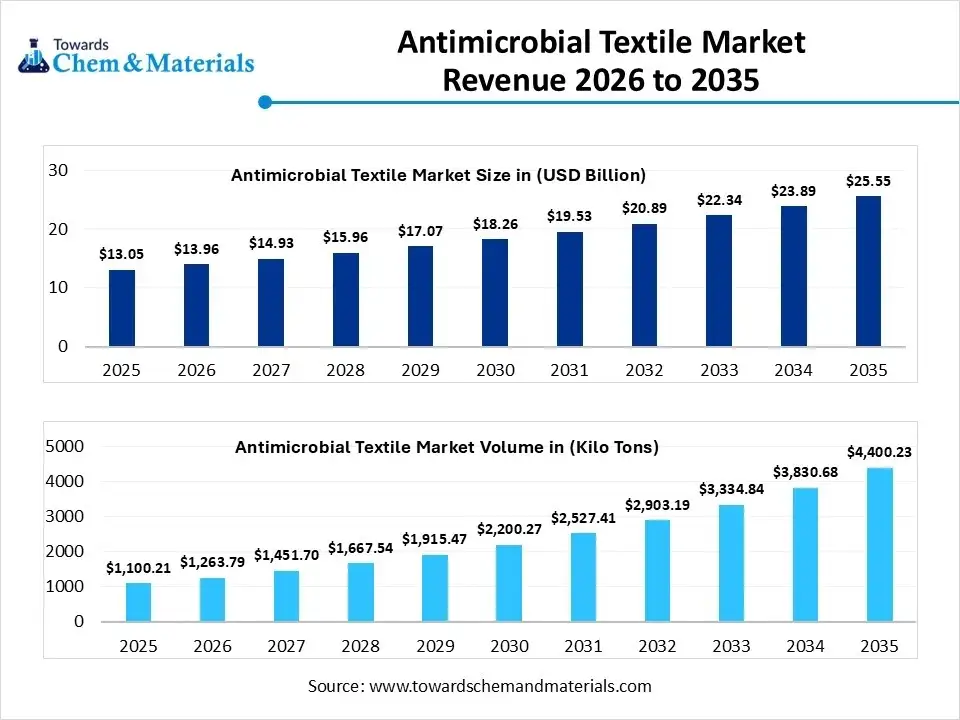
According to Towards Chemical and Materials, the global antimicrobial textile market size was estimated at USD 13.96 billion in 2026 and is expected to be worth around USD 25.55 billion by 2035, exhibiting a compound annual growth rate (CAGR) of 6.95% over the forecast period from 2026 to 2035. A study published by Towards Chemical and Materials a sister firm of Precedence Research.
Ottawa, Feb. 23, 2026 (GLOBE NEWSWIRE) -- The global antimicrobial textile market size was estimated at USD 13.05 billion in 2025 and is expected to increase from USD 13.96 billion in 2026 to USD 25.55 billion by 2035, growing at a CAGR of 6.95% from 2026 to 2035. In terms of volume, the market is projected to grow from 1100.21 kilo tons in 2025 to 4400.23 kilo tons by 2035. growing at a CAGR of 14.87% from 2026 to 2035. North America dominated the antimicrobial textile market with the largest volume share of 35% in 2025. The antimicrobial textiles market is driven by demand for hygiene, bio-based innovation, regulation for infection control, and industrial expansion.
Download a Sample Report Here@ https://www.towardschemandmaterials.com/download-sample/6185
Transforming Textiles with Hygiene and Innovation
Antimicrobial textiles are engineered materials with specialized natural agents that inhibit bacteria, yeast, fungi, and viruses. This market is a combination of textile engineering and biotechnology to offer bio-protection and material preservation. Market categorization depends on active chemistry from traditional metal ions to emerging bio-based polymers. As industries shift toward functionalized surfaces that promote hygiene, odor control, and longevity across medical, apparel, and industrial sectors, boosting their demand.
Request Research Report Built Around Your Goals: sales@towardschemandmaterials.com
Antimicrobial Textile Market Report Highlights
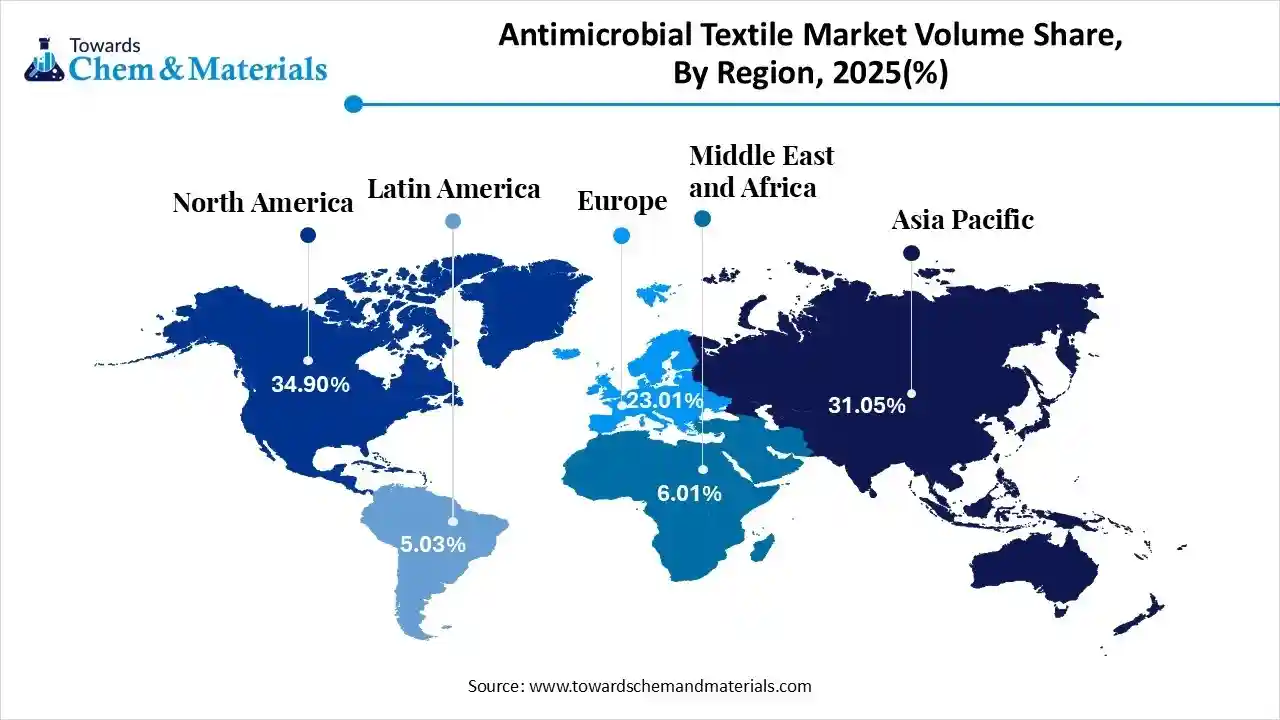
- The North America dominated the antimicrobial textile market with the largest volume share of 35% in 2025.
- The antimicrobial textile market in Asia Pacific is expected to grow at a substantial CAGR of 18.26% from 2026 to 2035.
- The Europe antimicrobial textile market segment accounted for the major volume share of 23.01% in 2025.
- By fabric type, the woven fabrics segment dominated the market and accounted for the largest volume share of 41.98% in 2025.
- By fabric type, the non-woven fabrics segment is expected to grow at the fastest CAGR of 19.99% from 2026 to 2035 in terms of volume.
- By active agent, the metal & metallic salts segment led the market with the largest revenue volume share of 61% in 2025.
- By fiber type, the cotton segment dominated the market and accounted for the largest volume share of 37% in 2025.
- By application, the medical textiles segment led the market with the largest revenue volume share of 46% in 2025.
Immediate Delivery Available | Buy This Premium Research Report (Global Deep Dive
USD 3200) @ https://www.towardschemandmaterials.com/checkout/6185
Key features
- Reviews key issues and technologies in the creation of antimicrobial textile products
- Offered a detailed overview of by antimicrobial agents and a wide range of important applications
- Produced by an experienced editor and a distinguished and international team of contributors
Benefits of antimicrobial fabrics and textiles
Antimicrobial additives equip fabrics and textiles with a host of performance benefits. The core benefits include:
- Odor-control : Bacteria are often responsible for unpleasant odors in our clothes and other textile products. During the metabolic process, they produce waste products that can smell if untreated. Antimicrobial technology targets odor-causing bacteria, tackling the issue at the source.
- Microbe-free ; Antimicrobial textiles are cleaner than fabrics that do not feature built-in protection. The antimicrobial additive protects the material from microorganisms and prevents mold and mildew from developing.
- Longer-lasting products : Left unchecked, microorganisms can damage textiles and cause the material to degrade. This shortens the product’s expected lifespan. By eliminating microorganisms, antimicrobials prevent this damage, resulting in longer-lasting products.
- More sustainable products : Because antimicrobials help keep textiles cleaner and odor-free, consumers can wash them less frequently. Less frequent washing reduces the environmental impact of a product, making it more sustainable and eco-friendly. It also contributes to longer-lasting textiles, as washing machines are tough on fabrics.
-
Integrated into products : As businesses introduce antimicrobial additives during manufacturing, the antimicrobial properties are ingrained in the fabric. This means they cannot be removed or washed away and ensures they provide around-the-clock protection for the product’s entire lifespan.
For more information, visit the Towards Chemical and Materials website or email the team at sales@towardschemandmaterials.com| +1 804 441 9344
Antimicrobial Textiles Market Report Scope
| Report Attribute | Details |
| Market Size and Volume in 2026 | USD 13.96 Billion / 1263.79 Kilo Tons |
| Revenue forecast in 2035 | USD 25.55 Billion / 4400.23 Kilo Tons |
| Growth rate | CAGR of 6.9% from 2026 to 2035 |
| Historical data | 2018 - 2026 |
| Forecast period | 2026 - 2035 |
| Quantitative units | Volume in tons and revenue in USD billion and CAGR from 2026 to 2035 |
| Report coverage | Revenue forecast, company ranking, competitive landscape, growth factors, and trends |
| Segments covered | By Active Agent, By Fiber Type, By Application, By Fabric Type, By Region |
| Region scope | North America; Europe; Asia Pacific; Central & South America; Middle East & Africa |
| Country scope | U.S.; Canada; Mexico; UK; Germany; France; Italy; Spain; China; Japan; India; Indonesia; Brazil; Saudi Arabia; UAE |
| Key companies profiled | Indorama Ventures Fibers Germany; Herculite; UNITIKA LTD; PurThread Technologies, Inc.; LifeThreads; Rajshree Fabrics; Baltex; U-LONG High Tech Textile Co., Ltd.; Milliken |
| Customization scope | Free report customization (equivalent up to 8 analysts’ working days) with purchase. Addition or alteration to country, regional & segment scope. |
Immediate Delivery Available | Buy This Premium Research Report@ https://www.towardschemandmaterials.com/checkout/6185
Private Industry Investments for Antimicrobial Textiles:
- Murata and Teijin’s PIECLEX Venture: These two Japanese giants launched a joint venture to produce a "carbon-neutral" fabric that generates an antimicrobial electric charge from the wearer's physical movement.
- 1888 Mills Technology Expansion: This major textile manufacturer invested in high-performance antimicrobial treatments for their commercial hospitality and healthcare linens to meet rising post-pandemic hygiene standards.
- HeiQ’s Strategic Partnerships: The Swiss innovator has secured significant private backing to integrate its silver-based "Viroblock" technology into global apparel brands like Burberry and Mammut.
- Milliken & Company’s Healthcare Acquisition: Milliken invested heavily in the acquisition and development of advanced wound care and medical textile technologies that utilize built-in antimicrobial barriers.
-
DuPont’s Bio-based Silvadur Development: DuPont has invested in scaling its Silvadur technology, which uses a polymer-based silver ion delivery system to provide long-lasting odor and bacteria control in athletic wear.
What Are Major Trends in the Antimicrobial Textiles Market?
- The Rise Focuses on Sustainable Alternatives: The environmentally conscious consumer is driving demand for bio-based alternatives, including essential oils, chitosan, and mineral-based ions.
- The Expansion of Cross-Industry: The emerging industries like automotive, home textiles, and public infrastructures are reshaping the market by focusing on antimicrobial properties and public hygiene.
-
Regulation for Infection Control: The rising healthcare-associated infection is a key driver for the adoption of antimicrobial lines, surgical gowns, and post-pandemic hygiene products.
Antimicrobial Textiles Market Dynamics
Driver
The Competitive Value Chain
The chemical formulator, textile manufacturers, and end-use producer increasing shift towards the development of antimicrobial additives and hygiene-maintaining fabric that driving substantial investment and collaboration between market players for the final antimicrobial benefit to the consumer.
Restraints
Higher Production Costs and Low Durability
The antimicrobial textile contains expensive raw materials that, unfortunately, drive high production costs over standard fabric, while some agents’ loss its efficiency after a few washes, leading to unreliable performance.
Opportunity
Copper-Based Wellness and Aviation Demand
The copper is gaining momentum for wellness benefits due to its antiviral properties in compression wear and recovery garments, that boosting opportunity for the copper-based market. While the aviation surge for self-sanitizing seat covers, hygiene assurance, and deep-cleaning cabins is also creating a massive opportunity for growth that primary focus on reducing labour costs.
Technology Redefined: Smarter, Faster, AI-enabled
Technological progress shifts antimicrobial textiles from surface coatings to molecular engineered barriers. The incorporation of nanotechnology creates high-surface-area metal ions and dendrimers for non-leaching protection without sacrificing breathability. AI accelerates innovation through predictive molecular modeling, aiding the discovery of bio-based alternatives and improving treatment and wash durability. Additionally, technological advancement is driving precision manufacturing, reducing waste, and enabling smart textiles to provide real-time health feedback, transforming ordinary fabrics into health-monitoring interfaces.
Antimicrobial Textile Market Segmentation Insights
Active Agent Insights
How Does the Metal & Metallic Salts Segment Dominate the Antimicrobial Textiles Market?
The metal & metallic salts segment is the leading market because it uses biocidal elements like silver, copper, and zinc, which disrupt microbes through an ion release mechanism, offering durable, non-leaching barrier properties. It's engineered through nanotechnology and high-efficacy antimicrobial protection, which makes them ideal for critical-care medical and technical apparel by maintaining hygiene and long-term odor suppression.
The bio-based agents’ segment is anticipated to grow fastest as the industry replaces heavy metals with natural, renewable biopolymers like chitosan and botanical polyphenols, providing eco-friendly, biodegradable defences that maintain skin microbiome integrity. As the market shifts towards circularity, the simple spray into covalently bonded or micro-encapsulated systems is suitable for wellness, infant wear, and luxury textiles with natural electrostatic disruption.
Fiber Type Insights
Which Fiber Type Segment Dominates the Antimicrobial Textiles Market?
The woven fabrics segment volume was valued at 461.87 kilo tons in 2025 and is projected to reach 1657.57 kilo tons by 2035, expanding at a CAGR of 15.26% during the forecast period from 2025 to 2035. The woven fabrics segment held the largest revenue share of 42% in the market in 2025, due to its structural stability and integrity, essential for high-performance practices like surgical gowns, drapes, and hospital linens that tolerate sterilization and industrial laundering without lowering efficiency. Its dense yarn interlacing offers a uniform surface that improves antimicrobial bonding and creates durable pathogen barriers. Wovens are versatile for home, and protective workwear ensures long-lasting hygiene.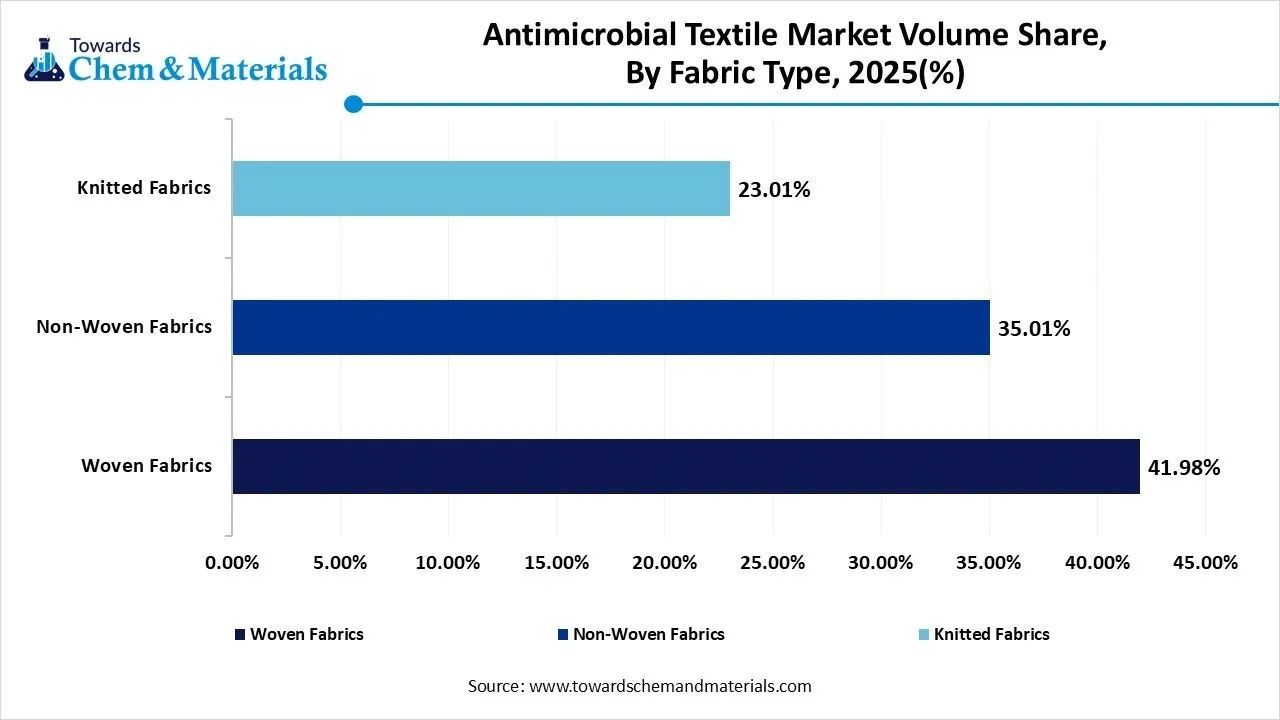
The non-woven fabrics segment volume was valued at 385.18 kilo tons in 2025 and is projected to reach 1985.38 kilo tons by 2035, expanding at a CAGR of 19.99% during the forecast period from 2025 to 2035. Driven by the transition to disposable healthcare and personal hygiene products. The key driver is the ease of integrating antimicrobials during web-bonding, which ensures uniform, cost-effective protection for single-use items. Non-wovens provide a lightweight and absorbent substrate, meet urgent infection-control needs by combining with high-volume manufacture and high biocidal efficiency, making them a dynamic segment for immediate hygiene safety.
Antimicrobial Textile Market Volume and Share, By Fabric Type, 2025-2035
| By Fabric Type | Market Volume Share (%), 2025 | Market Volume (Kilo Tons)2025 | Market Volume (Kilo Tons)2035 | CAGR(%) 2026-2035 | Market Volume Share (%), 2035 | |||
| Woven Fabrics | 41.98 | % | 461.87 | 1657.57 | 15.26 | % | 37.67 | % |
| Non-Woven Fabrics | 35.01 | % | 385.18 | 1985.38 | 19.99 | % | 45.12 | % |
| Knitted Fabrics | 23.01 | % | 253.16 | 757.28 | 12.95 | % | 17.21 | % |
Application Insights
Why did the Medical Textiles Segment hold the biggest share in the Antimicrobial Textiles Market?
The medical textiles segment dominated the market, its is act as a proactive, biocidal infrastructure that features high-potency antimicrobial agents embedded in surgical gowns, wound dressings, and sterilised medical fabrics. Its ability to withstand sterilisation and fight resistant pathogens is driving its adoption in industrial-scale sterilization and fostering innovation for wound-care systems. Overall, it is serving as a critical, self-sanitizing medical infrastructure.
The apparel segment is experiencing the fastest growth in the market during the projected period. It is characterized as a consumer-based segment that focuses on personal hygiene and garment longevity. It incorporates antimicrobial agents directly into fibers, forming a permanent, self-sanitizing barrier that prevents odour and microbial growth. The innovation focuses on non-leaching formulation for extending garment lifespan, and improving hygiene, especially for athleisure and everyday wear, that driving its versatility in modern garments' infrastructure.
Fabric Insights
How did the Woven Fabrics Segment hold the Largest Share of the Antimicrobial Textiles Market?
The woven fabrics segment led the antimicrobial textiles adoption, as it provides a high-density, durable substrate for antimicrobial textiles, enabling uniform integration of active agents through molecular grafting. Innovation moves toward inherent yarn technology, embedding antimicrobial properties into fibers before weaving, ensuring durability in high-traffic environments like medical and industrial landscapes to prevent sterilization stresses and prevent microbial colonization.
The non-woven fabrics segment is an emerging segment projected to grow at a CAGR between 2026 and 2035. It is essential for single-use PPE and filtration, created by bonding fibers into a porous trap that facilitates active antimicrobial agents. Advanced technologies like melt-blown and spun-bond enable these antimicrobial additives to be incorporated during fibre production, making them ideal for disposable healthcare products and air purification, preventing bacteria and viruses in high-risk areas.
Regional Insights
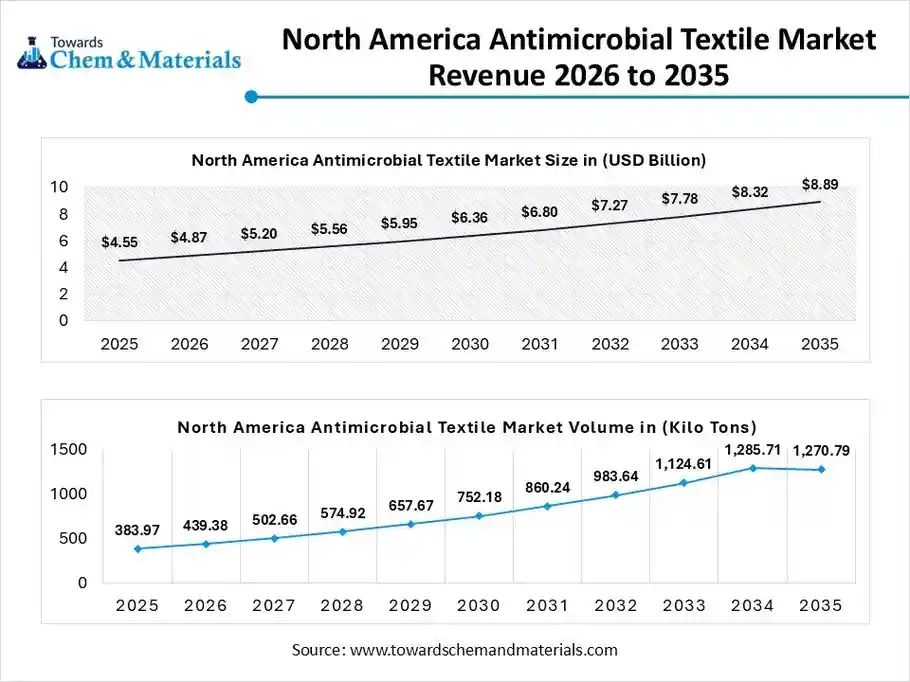
The North America antimicrobial textile market size was valued at USD 4.55 billion in 2025 and is expected to be worth around USD 8.89 billion by 2035, exhibiting at a compound annual growth rate (CAGR) of 6.93% over the forecast period from 2026 to 2035. By volume, the market is projected to grow from 383.97 kilo tons in 2025 to 1,270.79 kilo tons in 2035. growing at a CAGR of 12.70% from 2026 to 2035.
How did North America dominate the Antimicrobial Textiles Market?
North America leads the market, supported by a strong healthcare infrastructure and research. The region aims to reduce infections through self-disinfecting linens, curtains, and surgical apparel. Beyond healthcare, antimicrobial fabrics are common in athleisure, outdoor gear, and bedding that driving its demand. The regional stringent regulations require rigorous safety testing for public health claims that foster innovation in non-leaching metallic and bio-based agents by setting global safety standards and domestic growth.
Antimicrobial Textile Market Volume and Share, By Region, 2025-2035
| By Region | Market Volume Share (%), 2025 | Market Volume (Kilo Tons)2025 | Market Volume (Kilo Tons)2035 | CAGR(%) 2026-2035 | Market Volume Share (%), 2035 | |||
| North America | 34.90 | % | 383.97 | 1270.79 | 14.22 | % | 28.88 | % |
| Europe | 23.01 | % | 253.16 | 1109.30 | 17.84 | % | 25.21 | % |
| Asia Pacific | 31.05 | % | 341.62 | 1545.80 | 18.26 | % | 35.13 | % |
| South America | 5.03 | % | 55.34 | 244.21 | 17.93 | % | 5.55 | % |
| Middle East & Africa | 6.01 | % | 66.12 | 230.13 | 14.86 | % | 5.23 | % |
U.S. Antimicrobial Textiles Market Trends
The U.S. is expanding as demand increases in healthcare and institutional settings to reduce infections and enhance hygiene, with strong adoption of antimicrobial linens, gowns, and protective fabrics. Technological advances like nanotechnology, smart textiles, and bio-based antimicrobial agents are enhancing fabric performance, durability, and sustainability, while consumer awareness about hygiene is boosting use in sportswear, bedding, and home textiles.
Why is Asia Pacific the Fastest-Growing Region in the Antimicrobial Textiles Industry?
Asia-Pacific is a global hub for high-volume production and rapid consumption, especially for antimicrobial textiles. The region blends a large industrial base with increasing public hygiene awareness. The growing middle-class demand boosts apparel, footwear, and home fabrics with self-sanitizing and odor-resistant features. The region focuses on innovation of cost-effective synthetic agents and bio-based alternatives to meet sustainability targets.
Overall, a major textile exporter, integration of advanced nanotechnology-infused fibers and high-performance fabrics for domestic and international markets is accelerating the expansion.
China Antimicrobial Textiles Market Trends
China is growing strongly as rising public health awareness, expanding healthcare infrastructure, and increasing disposable incomes are driving demand for hygiene-enhancing fabrics in medical, sportswear, home, and industrial applications. China remains a major production hub with significant manufacturing capacity and export dominance, supported by advanced textile technologies such as nanotechnology-based antimicrobial treatments and high-performance coatings that improve durability and efficacy.
Europe Antimicrobial Textiles Market Trends
The antimicrobial textiles market in Europe is positively impacted due to the launch of the Circular Economy Action Plan as a part of the Green Deal by the European Commission. Furthermore, the European Union's REACT project addresses antimicrobial acrylic textiles waste management from outdoor awnings and furnishing. Growing focus on developing a green economy and supportive government regulations are projected to drive the market growth over the forecast period.
The UK antimicrobial textiles market is expected to witness growth over the forecast period.England is the birthplace of many modern sports, including cricket, football, rugby, badminton, tennis, boxing, golf, cycling, and motorsports. The demand for antimicrobial textiles is expected to grow due to the growing trend for sports in the UK. Conventional textiles generate bacteria and odor from excessive sweat while playing sports, whereas antimicrobial textiles prevent the growth of bacteria, making them more suitable for sports applications. This is expected to create the demand for these textiles in the coming years.
Central & South America Antimicrobial Textiles Market Trends
The antimicrobial textiles market in Central & South America is anticipated to witness significant growth from 2024 to 2030. It is an emerging market and antimicrobial textiles are being adopted in apparel, healthcare, home textiles, and other sectors.
The Brazil antimicrobial textiles market accounted for a majority of the revenue share in 2023. The industry growth is largely supported by the humid weather conditions in Brazil, which increases the requirement for fabrics that prevent bacteria and odor. In addition, Brazil has a large number of textile manufacturers. It is a major market that exports fabrics to other countries, including the U.S. These factors are anticipated to fuel the demand for antimicrobial textiles in the region.
Middle East & Africa Antimicrobial Textiles Market Trends
The Middle East & Africa antimicrobial textiles market is gaining widespread acceptance for the manufacturing of hospital beddings, uniforms, and towels in the healthcare sector. Consumer awareness about Hospital Acquired Infections (HAI) and the development of natural plant-based antimicrobial coatings are fueling market growth, particularly in healthcare facilities.
The antimicrobial textile market demand in Saudi Arabia is anticipated to grow at a higher rate over the forecast period owing to the climatic condition of the country, including high temperature and humidity, which creates conditions of fungal and bacterial growth, making antimicrobial fabrics a desirable option to maintain freshness and hygiene in clothing. In addition, government initiatives to promote healthcare and hygiene standards are further likely to fuel the demand for antimicrobial textiles.
Top Companies in the Antimicrobial Textiles Market & Their Offerings:
- DuPont de Nemours, Inc.: Provides SILVADUR™ silver-ion technology and Tyvek® IsoClean® for high-performance odor control and cleanroom protection.
- BASF SE: Offers specialized antimicrobial polymer additives and hospital-grade coatings for medical textiles and curtains.
- Indorama Ventures: Supplies antimicrobial polyester yarns and the deja™ Care range of hygienic PET fibers through its subsidiaries.
- Thai Acrylic Fibre Co.Ltd: Produces Amicor™ fiber, which features built-in antimicrobial additives that slowly diffuse for permanent protection.
- Toyobo Co.Ltd: Manufactures Feelfresh and Epicomodo functional fibers that inhibit bacterial growth using embedded metal ions.
- Herculite Products Inc.: Features Sure-Chek® fabrics, utilizing a patented controlled-release system for medical and healthcare environments.
- Sanitized AG: Develops diverse antimicrobial treatments, such as Silvertec™ and Puretec™, for integrated hygiene and odor management.
- Microban International, Ltd.: Partners with manufacturers to integrate AEGIS Microbe Shield® and Scentry® technologies directly into textile fibers.
- PurThread Technologies, Inc.: Embeds recycled silver salts into the core of synthetic fibers to ensure permanent, non-leaching efficacy.
- HeiQ Materials AG: Known for HeiQ Viroblock and other bio-based coatings designed for rapid antiviral and antibacterial performance.
- Sciessent LLC: Offers Agion® technology, a smart zeolite carrier system that releases silver and copper ions only when moisture is present.
- Milliken & Company: Provides BioSmart™ technology for medical scrubs and linens that kills bacteria on contact when laundered with bleach.
- Vestagen Protective Technologies, Inc.: Produces Vestex® healthcare apparel, which combines a fluid-repellent barrier with antimicrobial protection.
- Unitika Ltd.: Distributes a variety of antimicrobial polymers and performance fibers for industrial, clothing, and clinical use.
-
Trevira GmbH: Manufactures Trevira CS Bioactive, a polyester fiber that integrates permanent flame retardancy with silver-based antimicrobial properties.
More Insights in Towards Chemical and Materials:
- Textile Market Size to Exceed USD 2.01 Trillion by 2034
- Textile Chemicals Market Size to Surge USD 50.84 Billion by 2034
- Bio-Based Textiles Market Size to Reach USD 113.43 Billion by 2034
- Textile Colorant Market Size to Hit USD 18.46 Billion by 2035
- Bioplastic Textiles Market Size to Hit USD 34.53 Billion by 2035
- Smart Textile Polymers Market Size to Hit USD 9.63 Million by 2035
- AI in Textile Market Size to Hit USD 68.44 Bn by 2035
- Technical Textiles Market Size to Surpass USD 481.15 Bn by 2035
- Geotextiles Market Size to Hit USD 28.90 Billion by 2035
- Europe Textile Market Size to Worth Around USD 410.94 Bn by 2034
- U.S. Textile Market Size to Surge USD 283.15 Billion by 2034
- Asia Pacific Textile Market Size to Hit USD 1,010.03 Bn by 2034
Antimicrobial Textile Market Top Key Companies:
- Indorama Ventures Fibers Germany
- Herculite
- UNITIKA LTD
- PurThread Technologies, Inc.
- LifeThreads
- Rajshree Fabrics.
- Baltex
- U-LONG High Tech Textile Co., Ltd.
- Milliken
Recent Breakthroughs in the Antimicrobial Textiles Industry
- In September 2024, Microban International announced a collaboration with CiCLO to enhance sustainable antimicrobial offerings. This strategic partnership aims to provide manufacturers with textiles that combine long-lasting antimicrobial performance with biodegradable fiber technology and help to reduce environmental impact.
Antimicrobial Textile Market Report Segmentation
This report forecasts revenue growth at global, regional, and country levels and provides an analysis of the latest industry trends in each of the sub-segments from 2019 to 2035. For this study, Towards Chemical and Materials has segmented the global Powder Coatings Market
By Active Agent
- Metal & Metallic Salts
- Silver
- Copper
- Zinc
- Synthetic Organic Compounds
- QAC
- PHMB
- Triclosan
- Bio-based Agents
- Chitosan
- Plant Extracts
- Others
By Fiber Type
- Cotton
- Polyester
- Polyamide
- Others (Wool, Silk, Blends)
By Application
- Medical Textiles
- Gowns
- Masks
- Bedding
- Apparel
- Activewear
- Intimates
- Workwear
- Home Textiles
- Curtains
- Towels
- Carpets
- Commercial & Industrial Textiles
By Fabric Type
- Woven Fabrics
- Non-woven Fabrics
- Knitted Fabrics
By Regional
- North America
- Europe
- Asia Pacific
- Latin America
- Middle East & Africa
Immediate Delivery Available | Buy This Premium Research Report@ https://www.towardschemandmaterials.com/checkout/6185
About Us
Towards Chemical and Materials is a leading global consulting firm specializing in providing comprehensive and strategic research solutions across the chemical and materials industries. With a highly skilled and experienced consultant team, we offer a wide range of services designed to empower businesses with valuable insights and actionable recommendations.
Our Trusted Data Partners
Towards chem and Material | Precedence Research | Statifacts | Towards Packaging | Towards Healthcare | Towards Food and Beverages | Towards Automotive | | Nova One Advisor | Nutraceuticals Func Foods | Onco Quant | Sustainability Quant | Specialty Chemicals Analytics | TCM Blog
For Latest Update Follow Us: https://www.linkedin.com/company/towards-chem-and-materials/
USA: +1 804 441 9344
APAC: +61 485 981 310 or +91 87933 22019
Europe: +44 7383 092 044
Email: sales@towardschemandmaterials.com
Web: https://www.towardschemandmaterials.com/


Legal Disclaimer:
EIN Presswire provides this news content "as is" without warranty of any kind. We do not accept any responsibility or liability for the accuracy, content, images, videos, licenses, completeness, legality, or reliability of the information contained in this article. If you have any complaints or copyright issues related to this article, kindly contact the author above.
